TAUP & TUGSA
February 25, 2026 2026-03-21 13:43TAUP & TUGSA
The Temple University Graduate Students’ Association (TUGSA) is the labor union for teaching assistants, research assistants, and graduate assistants at Temple. Our university relies on the labor of graduate student workers. Graduate student workers do a variety of different types of work at Temple in collaboration with TAUP faculty. Graduate student workers…
- Teach: Many serve as graders, recitation leaders, instructors of record, and tutors at the Writing Center.
- Research: Graduate student workers work alongside faculty in labs and in clinical settings to run experiments and contribute to publications.
- Practice: Some graduate students work as academic advisors and mental health professionals for fellow graduate and undergraduate students
- Support: Other graduate students work in the graduate school and other administrative offices doing academic program support work.
TAUP and TUGSA share a commitment to mission of Temple University and have a long history of working together on campaigns to improve the quality of education and the culture of work on campus. Members of the TAUP bargaining unit have a vested interested in ensuring protections for graduate student workers and protecting graduate education and work at Temple.
TUGSA is fighting for rights and benefits that graduate workers need and deserve – and that will also set important precedents for the entire Temple community. These proposals include SEPTA card reimbursement and a new article developed to reduce the practical risks international employees face in maintaining immigration status, employment, and safety.
They are also proposing an additional new article for inclusion, Intellectual Property and Generative Artificial Intelligence. The article establishes course materials as the legal property of the instructor – a protection absent from Temple’s “Inventions & Patents” intellectual property policy – and was expanded following conversations with TAUP leadership about members’ concerns regarding Temple’s growing use of generative artificial intelligence (GAI). TUGSA’s article includes:
- Prohibition on the university or its contractors using employee teaching materials to train or develop AI systems
- Requirement that course delivery, grading, and feedback remain performed by humans
- No default-enabled GAI features in LMS platforms (separate from AI accessibility review tools)
Here are some programs that we’ve worked on collaboratively in the past:
- In 2021, Temple administration announced the need for a 5% mid-semester budget cut in order to “balance the budget” in the wake of COVID. This was leading to cancellation of courses and non-renewals of long serving faculty.
- TAUP + TUGSA worked together to do a budget analysis of Temple’s current financial situation and found that they had made over $300 million in profit that year.
- In response, we worked together and launched Temple Made Millions. This campaign focused on publicizing their profit margins and the need to invest in our educational and research mission, instead of divesting from it.
- We worked collaboratively to put together templemademillions.com, a website that broke down Temple’s financial documents and called for a re-prioritization of Temple’s budget that we then spread to the Temple community.
- With rising pressure due to the campaign, Temple administration stopped the budget cut that they had said was inevitable.
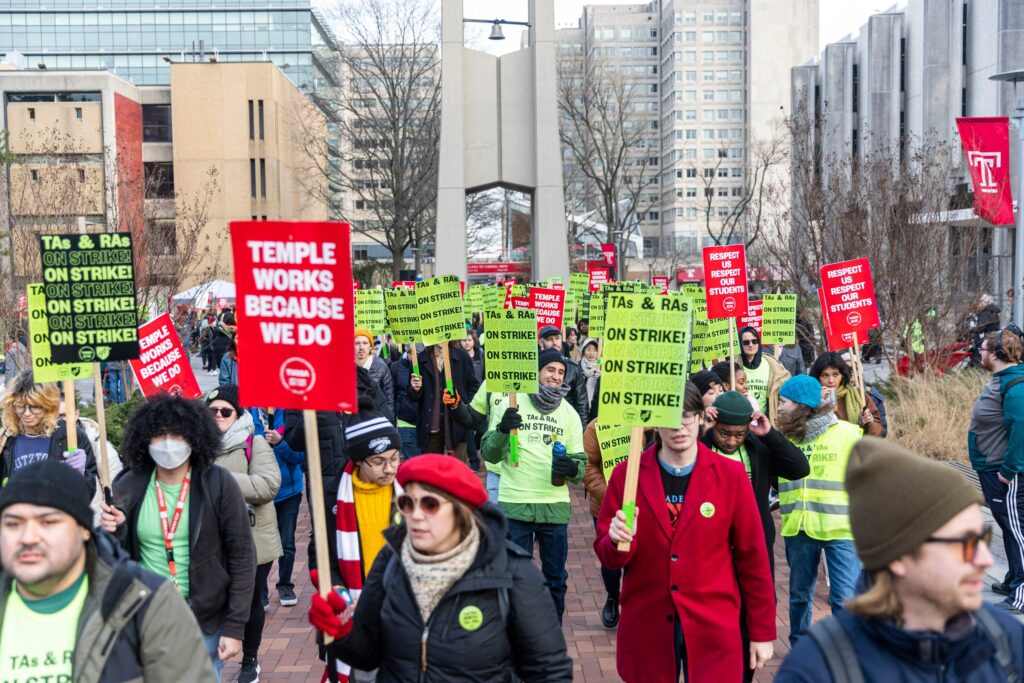
- In 2023, graduate workers in TUGSA held a 6-week long strike after over a year of failed contract negotiations. During negotiations, newly appointed Temple University President Jason Wingard was not present or willing to engage with TUGSA.
- At the same time, TAUP faculty were growing increasingly frustrated with the lack of engagement from the President’s office and even physical presence. Faculty were having massive issues with the office of research, there were concerns about the vacancies and effectiveness of the office of enrollment.
- On week 5 of the strike, Temple announced they would be taking away healthcare access and tuition remission for striking graduate workers. This sent ripples throughout the university and faculty and students began organizing to hold administration accountable.
- As TUGSA continued to hold their picket line, TAUP faculty from across the university wrote letters to administration in support of their graduate workers.
- TAUP began hosting meetings about a potential Vote of No Confidence on then President Jason Wingard, Provost Greg Mandell, and Board of Trustees president Mitch Morgan. In response to the clear mismanagement, hundreds of faculty, librarians, and academic advisors decided to go forth with a Vote of No Confidence, the first of its kind at Temple.
- The pressure of the strike and decision to carry through with the vote resulted in the resignation of President Wingard.
- Understanding the leadership issue went beyond the President’s office, The Vote of No Confidence launched just a few days after TUGSA settled their historic contract. Over 1000 TAUP members participated with over 80% voting no confidence, leading the resignation of President Jason Wingard.
What you need to know as a grad student supervisor (“dos and don’ts”)
The Individual Declaration of Academic Benefit (DAB) form is included with all RA appointment letters. In this form, RAs must indicate whether their research duties in a given semester or assignment provide a “direct academic benefit,” meaning the work will contribute directly to their thesis or dissertation.
While this may seem like a small administrative matter, the implications are quite serious. For graduate workers with 100% RA appointments, signing to receive DAB removes them from the TUGSA bargaining unit, meaning they are no longer represented by the union nor guaranteed the protections of the TUGSA Collective Bargaining Agreement (CBA). Losing these rights is troubling enough on its own, but it is also important to note that the DAB procedure is entirely unique to Temple; we know of no other university, including those with graduate researcher unions of their own, that has DAB or anything like it.
- Encourage your research assistants to reach out to TUGSA with any questions related to DAB
- Don’t direct your research assistant to sign the DAB form in any way or rush them into a decision
- If a graduate student is assigned work as a teaching assistant, they are in the union regardless of whether they are on DAB
Compensation levels (including benefits) are set by the TUGSA collective bargaining agreement. The TUGSA contract does not require graduate student benefits to be taken out of your research grant. That is a decision made by the Temple administration, de-prioritizing the success of your lab in its budgetary decisions.
Graduate workers are an integral part of the labor that keeps Temple University functioning. From teaching courses to doing research, our university is able to function due to the work of both units. Here are some things to keep in mind as a supervisor:
- Your roll as supervisor is limited to directing their enumerated job duties outlined in their contract. If they are assigned to teach a specific class or grade for one of your classes, you cannot ask them to do grading or course prep work for another course. Similarly, you shouldn’t have them do extraneous work like picking up your dry cleaning or walking your dog as part of their normal duties. We jest but also know these things have happened.
- Remember that graduate student workers have hours set by their CBA and individual contracts. They are not available to you for an unlimited amount of work and you should be cognizant of the workload and expectations you make of them.
- They are workers with lives outside of the university. They are parents, children, spouses, and partners, and we should treat them with the respect that we expect for ourselves.
You should maintain clear boundaries between a graduate student’s work as an employee and any academic work that they produce in their capacity as a student. Academic issues should be addressed through academic avenues. Employment issues should be addressed through employment avenues. You should not punish a student on their work for something that happened during their “work time” and vise versa. Similarly, students should be allowed to change their academic advisors and committee members without being punished either as students or in their work relationships.