
Strike FAQ
January 12, 2026 2026-01-14 18:23Strike FAQ
Strike 101
A strike is the ultimate form of power by employees. It is a collective decision by employees to refuse to continue all their work. The key word in this definition is collective. Union members voting to strike will also decide collectively on the objectives of the strike and when to end it.
Workers strike to win dignity and respect on the job when an employer has refused to give it to them. The strike demonstrates that workers’ labor is the essential core of any enterprise, and that without people willing to do the work, “business as usual” can’t continue.
Since Temple is a state-related university and receives public appropriation funding from the taxpayers of Pennsylvania, the laws governing the behavior of Temple unions and the Temple Board of Trustees fall under Pennsylvania labor law and are adjudicated by the Pennsylvania Labor Relations Board.
Public employees in Pennsylvania are subject to certain limitations that do not apply to private sector employees, but they also have certain rights and protections that private sector employees do not have. The Pennsylvania Public Employee Relations Act states that a strike is legal only when:
- A union’s collective bargaining agreement (CBA) has expired.
- The union and Temple have engaged in negotiations with a mediator present, reached a point of impasse, and exhausted the PA Labor Relations Board’s (PLRB) fact-finding process.
- An impasse has been reached when both sides, negotiating in good faith, are unable to reach an agreement on outstanding issues. Once enough proposals have been exchanged that it’s clear an agreement can’t be reached, either party can declare that an impasse exists.
- You can view the full text of PERA here.

A picket line is a specific tactic that both brings public attention to workers dissatisfaction with their employer as well as deters others from entering a place of work. Picket lines are meant to disrupt the normal functioning of a workplace.
Informational Pickets – An informational picket line is one where the workers demonstrate to their employer and the public that they are ready to strike as well as bring attention to the dissatisfaction of workers at their workplace. An informational picket is not a work stoppage. In essence, informational picketing is a warning to the employer of what could come if she refuses to accede to the union’s demands.
Strike Pickets – A strike picket line is one that occurs after workers decide to go on strike
Crossing a picket line is a decision by a worker or patron to undermine another worker’s ability to win dignity and respect on the job by continuing to work at or patronize the workplace being picketed. To cross a picket line does not require there to be a physical picket line, but simply to use or produce a service or product a struck workplace is offering.
Scabbing is when a person decides to do the work of another worker on strike and/or undermines the ability of that worker and her union to win respect and dignity on the job. Examples include:
- Teaching a class of a striking instructor or adding a student of a striking instructor’s class to yours
- Covering a striking faculty member’s service obligations for your department
- Performing research work normally assigned to a lab worker on strike
- Covering administrative labor of a worker on strike
A strike itself does not create work for you; it is Temple administration that is asking you to do more work by serving as a strikebreaker. They are asking you to do the jobs of striking workers on top of your own job, and to surveil and report on strikers to facilitate administrative retaliation. You have no obligation to do these things and should simply decline.
When one worker is undermined by another, it signals to the employer that she can continue to treat her workers badly. This creates a race to the bottom, where everyone is worse off and creates an environment where scabbing is acceptable. If you are worried about the effects of a strike on your workplace, scabbing will extend the duration of the strike. Not scabbing will put more pressure on the employer to come to the table and agree to a fair contract, thus ending the strike quicker. Workers coming together in actions of solidarity are the basis for winning dignity and respect on the job – scabbing erodes that solidarity.
Union-busting is a strategy developed deliberately by employers and “union-avoidance” institutions designed to weaken the power of workers through misinformation and fear. At core, the goal of union-busting is to “third-party” the union – convincing workers that their union is actually not theirs.
There are three categories of union-busting activities…
- Divide: Employers will try to sow division between workers in a union and at a workplace because they understand that solidarity is the strength of any union campaign. Historically, this has been done on the basis of race, gender, ethnic background, and type of work people do.
- Example: “The reason we can’t give you a raise is because the union wants us to spend more money on those workers and not on you.”
- Delay/Distract: Due to the nature of labor law in the United States, the longer an employer can delay a union vote or agree to a collective bargaining agreement, the more she has at her disposal to undermine the strength of the union. The effects of delay are then used by the employer to sow division within the union. When workers decide to organize unions in the United States, over 3/4 of employers hire anti-union law firms and consultants to combat them. Since the 1970s, these firms have provided employers with a standardized repertoire of anti-union tactics that are used across the U.S. economy. One tactic is to drag out contract negotiations for years. The goal is to demoralize workers, convince them that it isn’t worth having a union, and ultimately organize workers to decertify the union—that is, to vote out the union that they just voted to create. Temple has a long history with “union avoidance” law firm Cozen O’Connor. Patrick O’Connor was formerly the Chair of the Temple Board of Trustees and the current Board recently hired longtime Cozen O’Connor lawyer, James Schultz, to serve on the Board. Temple employs another notorious “union avoidance” firm, Ballard Spahr, as outside counsel for TAUP’s contract negotiations and enforcement cases.
- Example: “The reason you haven’t gotten a raise is because the union’s negotiations team has been unrealistically stubborn with us and unprofessional. You should tell union leadership to compromise so we can have an agreement.”
- Dominate/Demoralize: Even though there are laws on the books that protect workers from employer abuse, the current balance of power in the United States makes it common that employers deliberately break the law to sow fear in their workers and undermine the union. The strategy behind this is to effectively demoralize workers in the present to break their solidarity and deal with the consequences (if any) of breaking the law later.
- Example: Even though an employer knows that non-citizens have the same rights as citizens when going on strike, they may tell a non-citizen worker: “You are not a citizen? You should talk to an immigration attorney about going on strike.”
- Example: An employer arrives at negotiations late consistently, disrespecting everyone’s time. This is deliberate – an attempt to indicate to workers that they don’t have to abide by the same rules.
- Example: Sending all workers a communication that says “Look at the current offer we’ve put forward. Isn’t it great? You should pressure union leadership to agree to it.”
- Temple sent communications like this in both the 2023 TUGSA strike and the 2023-24 TAUP CBA negotiations in a way that arguably violated state labor law. Both campaigns ended before the PLRB could issue a ruling.
TAUP stands in solidarity with the 11 other unions on campus and want to empower our members and community members to do so as well.This page provides an overview of strikes for members of the Temple community and in particular for members of the TAUP bargaining unit. There are sections that address the following:
- What the TAUP CBA says about striking and strike support activities.
- What Temple’s administration might do and has done in response to strikes
- How to support striking worker in other unions at Temple
- An FAQ on what to do during a strike
- Information about possible TAUP strike activity.
What does TAUP’s CBA say about strikes?
Article 10 of the TAUP CBA states that TAUP, its members, and its leadership shall not strike unless our CBA is expired. Article 10 further states that TAUP, its members, and its leadership shall not “directly or indirectly” support a strike or picket at Temple University or other Temple worksites (such as Temple Hospital), and requires TAUP to publicly disavow such actions if they do occur. Individual employees may be subject to discipline if Temple administration can prove they have violated Article 10. You can view the full text of Article 10 here: https://taup.org/taup-contracts-articles/
TAUP believes Article 10 limits our rights well in excess of state labor law and consistently works to narrow its scope so that our CBA permits us to take all lawful support actions. All unions at Temple have similar language in their CBAs. Temple administration fights back on any attempt to modify this language, because they know that it makes it harder for Temple’s workers to support each other and weakens our power.
However, Article 10 DOES NOT:
- Bar TAUP from striking after our CBA has expired, as long as we have followed the additional legal steps required by state law (see above).
- Limit the supporting actions TAUP or members can take prior to a strike, whether as part of a TAUP action or as individual supporters of another union at Temple, such as attending rallies or informational pickets that are not work stoppages.
- Limit TAUP’s ability or your ability to support strikes taking place at other employers in any way.
- Limit your ability to express support for striking workers that does not aid the strike itself. Many examples can be found in the next section of this FAQ.
- Waive your existing rights to protection from unfair discipline if Temple administration attempts to discipline you for supporting a strike.
- Temple administration must still follow all normal discipline processes in our CBA to discipline you, and has the burden of proof to show your conduct merits discipline. You are entitled to union representation throughout the discipline process.
- Require TAUP to disavow individuals supporting a strike unless Temple administration notifies TAUP of such individuals.
- Require TAUP to do anything but disavow your actions and tell you to stop them if Temple administration notifies TAUP that it believes you have violated Article 10.
- Require you to voluntarily scab, voluntarily cross a picket line, retaliate against striking workers, or voluntarily engage in any other activity which undermines a strike. You may be subject to discipline if you refuse a direct order from a supervisor to perform certain tasks during a strike. Conversely, some direct orders from supervisors may themselves be unlawful. See later sections of this FAQ for more examples, and always contact TAUP if you have questions about a specific incident.
Temple administration must still follow all normal discipline processes in our CBA to discipline you, and has the burden of proof to show your conduct merits discipline. You are entitled to union representation throughout the discipline process.
What might Temple's administration do in response to a strike?
This is usually legal. However, threatening or coercing other Temple employees to scab may be unlawful. Contact TAUP immediately if anyone tries to force you to scab.
For example, during the TUGSA strike in 2023, Temple administration offered TAUP members extra money to scab work that was normally done by TUGSA members in an attempt to undermine the strike.
Temple administration will turn to internal scabs before external scabs whenever possible.
- This option is cheaper than engaging a staffing agency or making additional external hires.
- Internal scabbing weakens all unions at Temple and plays into the hands of Temple administration, which wants to keep us divided.
This tactic fails if every worker at Temple stands behind each other during any strike and refuses to voluntarily scab. Temple administration is then forced to use other, more disruptive options to try and end the strike, or to negotiate in good faith and quickly reach a fair contract.
If not enough people from within Temple will scab, Temple administration will hire scabs from other sources. This is legal, but through solidarity with other higher ed unions, we can and should discourage workers from crossing the picket line.
- For example, Temple administration hired scabs from other universities during the TUGSA strike in 2023.
- Temple administration was prepared to bring in scab labor if campus security officers went on strike in 2025.
This tactic fails if workers throughout the area stand behind each other during any strike and refuse to scab. Temple administration is then forced to use other, more disruptive options to try and end the strike, or to negotiate in good faith and reach a fair contract.
Under PERA, public employers are not required to maintain pay and benefits for public employees who are on strike, or to provide back pay. Back pay is normally provided as part of the deal to end a strike. Temple administration attempted to cut off not only TUGSA workers’ pay, but also their tuition remission and health insurance benefits during the TUGSA strike in 2023. This tactic backfired, bringing national attention to Temple administration’s behavior and contributing to TUGSA’s wins. Cutting off benefits is likely unlawful, but the TUGSA strike ended before the PLRB could issue a ruling on this question.
Under PERA, an otherwise lawful strike by public employees may be stopped by the PA Court of Common Pleas if the strike poses “a clear or present danger or threat to the… welfare of the public.” Temple administration initiated this process in TAUP’s 1980 and 1990 strikes, but did not do so for TUGSA’s 2023 strike. More recently, the City of Philadelphia used this process against several groups of municipal service workers represented by AFSCME DC 33 during their Summer 2025 strike. The Court of Common Pleas makes a fact-specific ruling on whether the specific strike in question presents a threat to the welfare of the public. If it believes such a threat exists, it can issue an injunction, ordering the striking workers to return to work. This ruling can be appealed, potentially all the way to the PA Supreme Court, which is the final authority. If an injunction is awarded by the court, unions who remain on strike and their individual members who continue to strike may face contempt of court charges.
A sufficiently large and militant strike deters the employer from attempting this pathway. Forcing a large group of organized and angry employees back to work often just makes things worse for the employer, both in the community as a whole and at the worksite. Even if an injunction is awarded, a sufficiently large and militant strike is impossible to effectively shut down through court action.
Threatening discipline, termination, or other retaliation for exercising legally protected rights is generally unlawful. Employers will do their best to instill fear in striking workers and their allies while staying within the law.
This tactic fails against a sufficiently large and militant strike, especially one with support from other unions and the broader community. If striking workers know they have support, they can feel safe ignoring employers’ threats and continuing the strike until they win.
This action is only lawful if Temple has secured an injunction against the strike. Otherwise, firing or otherwise disciplining striking workers for exercising their legal right to strike is a violation of state labor laws.
A sufficiently large and militant strike deters the employer from attempting this pathway. It’s simply not possible to replace a large group of workers all at once without massive disruptions and long-term damage to the institution.
How can I support striking workers from other unions at Temple?
While all unions at Temple have language in their collective bargaining agreements that is similar to Article 10 of TAUP’s collective bargaining agreement with Temple, and that language does not permit us to directly support a strike against the university or the operation thereof, there are steps we can take to support Temple workers in their fight for a fair contract and the union labor that powers this university. TAUP members may be subject to discipline for supporting a strike at Temple in ways that violate Article 10. As with all discipline, TAUP members have just-cause protection under the CBA: Temple has the burden of proof to show that you engaged in the conduct at issue to discipline you, and you are entitled to union representation in any discipline proceeding.
Remember, this information applies only to strikes at Temple, and does not apply to any labor action at any other entity (e.g. CCP, Penn, Starbucks). You can take any lawful solidarity action in support of non-Temple strikes without penalty. It’s unlawful for Temple administration to retaliate against you for lawful solidarity actions taken outside Temple; report any such incidents to TAUP immediately.
If Temple can prove that the union as a whole, the union officers, or union members were involved in an unlawful work stoppage by another union or other group of workers, under PERA, the same penalties that the striking workers face could be applied to any solidarity strikers. The union as an organization can also be sanctioned if tied to an unlawful strike. Should an unlawful work stoppage happen at Temple, look to TAUP for further guidance at that time.
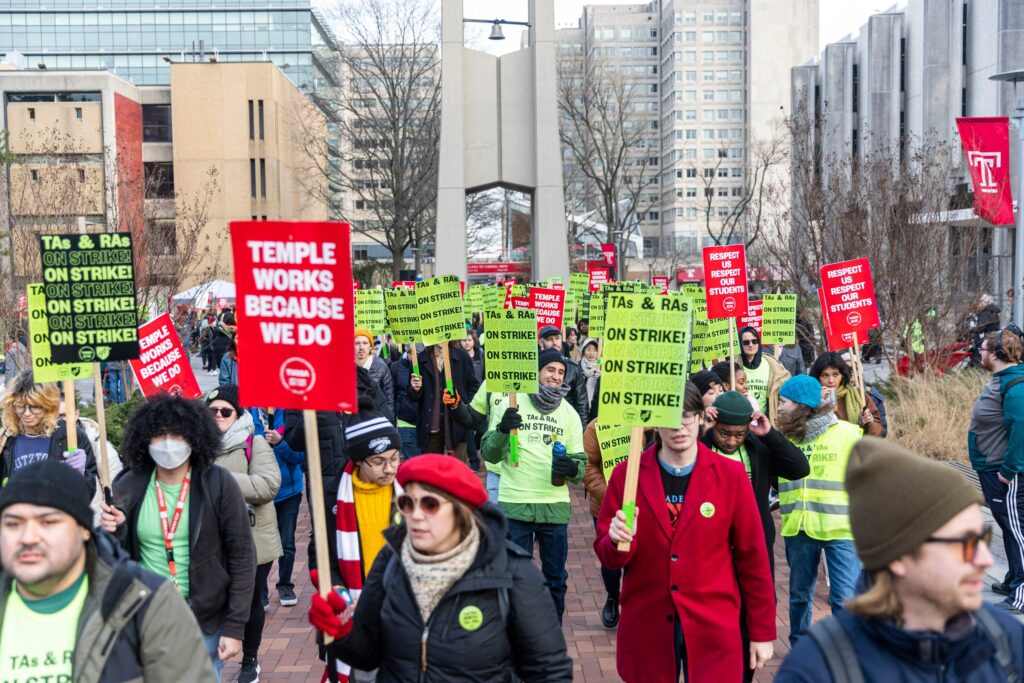
Here are some ways for faculty, academic professionals, and librarians to show solidarity in the event of a strike of another union at Temple:
You can show your support by attending rallies, informational pickets, and other events that aren’t actual work stoppages.
You can show your support for negotiations by signing a public letter of support for striking workers, stating your support for their demands and encouraging Temple administration to negotiate fairly over them. TAUP will communicate about these issues in the event of a strike at Temple.
You can tell your students about the strike and answer questions they may have. If you’re not sure how to answer their questions, direct them to someone who can. TAUP will try to provide specific contact information for the striking union(s).
You can publicly show support for workers’ demands and good faith negotiations from Temple administration. You can sign public letters of support, contact state and local politicians, share supportive posts on social media, and tell striking workers that you hope they win a fair contract.
You can wear pro-union swag or swag items from the striking union(s) that don’t directly reference the strike, including items that support striking workers’ contract demands.
If you normally have discretion over your work location or modality, you can use that discretion to perform your work without crossing a physical picket line. You must follow any supervisor instructions about work location or modality, even if this results in crossing a picket line. You should contact the Union at office@taup.org regarding any changes to your work as a result of a strike at Temple.
You can supply food or drinks to striking workers – as long as you are not giving items to individuals on the picket line and are not distinguishing between those who choose to picket and those who don’t.
Giving money to a strike fund during a strike counts as providing direct support for that strike, but the burden is on Temple to demonstrate that you did so before you can be disciplined. You are entitled to union representation throughout the discipline process.
What do I do if…
People have a lot of questions about what to do if a strike at Temple is called. Below are some answers to commonly asked questions we’ve received about what to do during or leading up to a strike. Remember, this information applies only to strikes at Temple, and does not apply to any labor action at any other entity (e.g. CCP, Penn, Starbucks). That said, you shouldn’t scab at other employers, cross picket lines at other employers, or believe management statements about a strike from other employers! You can take any lawful solidarity action in support of non-Temple strikes without penalty. It’s unlawful for Temple administration to retaliate against you for lawful solidarity actions taken outside Temple; report any such incidents to TAUP immediately.
Document the request; contact TAUP immediately
Politely but firmly object to performing the work
- If enough people do this, administrators are pressured to cover the work themselves or hire scabs from outside Temple. This puts additional pressure on the university administration to quickly reach a fair contract and end the strike.
If directly ordered to cover a striking worker’s work:
- If the work is outside your normal job duties, it should not be reassigned to you – ex: being reassigned to cover building security or clean floors. Politely but firmly object again to performing the work, noting that it falls outside of your normal job duties, and notify your supervisor that you are reporting this to your union.
- If the work is within your normal job duties, you can be disciplined if you refuse to perform the work. Normal job duties are the general type of work you perform, e.g. teaching classes, not your specific course assignment.
- Temple administration must comply with the workload rules in the TAUP CBA, which limits the amount of extra work you can be ordered to do.
- If you refuse, Temple administration must still follow all normal discipline processes in our CBA to discipline you, and has the burden of proof to show your conduct merits discipline. You are entitled to union representation throughout the discipline process.
- Cover only the work that you are directly ordered to cover. Don’t go “above and beyond” while working under duress
Ask about/offer alternative ways of doing your work that don’t require crossing a physical picket line. If your normal job duties don’t require you to cross a physical picket line (e.g. you work remotely), you should object to any changes to your work assignment that would require you to begin crossing a picket line.
If you are directly ordered to cross a picket line, you may be disciplined if you refuse. Temple administration must still follow all normal discipline processes in our CBA to discipline you, and has the burden of proof to show your conduct merits discipline. You are entitled to union representation throughout the discipline process.
Document all conversations and keep any written communications you receive.
Contact TAUP immediately for individual case assessment.
Say that you prefer not to answer.
Document the conversation.
If pressed or directed to answer, say something neutral and politely end the conversation as quickly as possible. Do not make any false statements.
- Forcing or trying to force you to give information on striking workers is a potential violation of state labor law.
- Contact TAUP immediately after the conversation is over for case assessment.
Say that you prefer not to answer.
Document the conversation.
If pressed or directed to answer, say something neutral and politely end the conversation as quickly as possible.
- Forcing or trying to force you to give your opinion on a labor action is a potential violation of state labor law.
- Contact TAUP immediately after the conversation is over for case assessment.
You should disregard all official statements about any strike from Temple administration. Temple administration will put out misleading information designed to undermine the community’s support for striking workers. Even technically accurate information will be provided without context or in misdirecting rhetorical frames. Be attentive to TAUP and other union communications, and be prepared to push back on Temple administration’s messaging.
You should view all such statements skeptically.
Even well-meaning, pro-labor supervisors will be operating under unreasonable constraints imposed by central Temple administration and with misleading information provided by central Temple administration. Even technically accurate information will be provided to them without context or in misdirecting rhetorical frames, just like the official statements you get.
Be attentive to TAUP and other union communications, and be prepared to correct misunderstandings and push back on misleading narratives.
Unofficial statements may contain valuable information about Temple administration’s approach to a strike; take them with a grain of salt, but report anything that seems interesting to TAUP for further investigation.
Pressuring any worker engaged in a lawful strike to return to work (whether they’re a union member or not) is a direct attack on the power of all unions at Temple, including TAUP. It may be a violation of state labor law, especially if you are the employee’s supervisor or in another position of relative power. You should not engage in pressure or retaliation of any type in an attempt to pressure striking workers into returning to work.
Instead, you should support the strikers as much as possible within the bounds of Article 10 and your own circumstances. The stronger and more effective their strike, the greater the pressure on Temple administration to quickly and fairly settle a fair contract, and the sooner they’ll be back to work.
Retaliation against any worker (whether they’re a union member or not) for engaging in a lawful strike is a violation of state labor law and a direct attack on the power of all unions at Temple, including TAUP. It is possible to engage in retaliation even if you are not a worker’s direct supervisor, or to retaliate against striking workers collectively. All such conduct is legally prohibited and morally reprehensible. You should not engage in retaliation of any type.
Retaliation against any worker (whether they’re a union member or not) for engaging in a lawful strike is a violation of state labor law and a direct attack on the power of all unions at Temple, including TAUP. It is possible to engage in retaliation even if you are not a worker’s direct supervisor, or to retaliate against striking workers collectively. All such conduct is legally prohibited and morally reprehensible. You should not engage in retaliation of any type.
Say that you are concerned that retaliation is unlawful and express severe discomfort. Document the conversation. If pressed or directly ordered to retaliate, politely end the conversation as quickly as possible.
- Ordering you to retaliate is a potential violation of state labor law.
- Contact TAUP immediately after the conversation is over for case assessment.
Unless you have been directly ordered by a supervisor, you don’t have to scab because a student asks. This includes helping students with things that should normally be handled by a worker who’s on strike. Instead, you should explain scabbing to the student and explain why you’re unwilling to scab. Wherever possible, direct students to supervisors/administrators to get their problems resolved. This puts more pressure on Temple administration to settle a fair contract.
Unless you have been directly ordered by a supervisor, you don’t have to cross a picket line because a student asks. Instead, you should explain the purpose of the picket line to the student and explain why you’re unwilling to cross it.
Feel free to give your thoughts as long as either:
- The strike is directly relevant to your course material;
- The discussion takes place outside official class times.
- Report such requests and/or management communications that seem relevant to TAUP so we can corroborate any information and make sure it reaches the leadership of the striking union(s) accurately.
- Unofficial statements by various individuals (colleagues, direct supervisors, etc.) may contain valuable information about Temple administration’s approach to a strike. However, even technically accurate information will be provided to them without context or in misdirecting rhetorical frames.
- Don’t spread rumors, management claims, or uncorroborated information.
- If you have specific knowledge of something, share it with TAUP leadership and/or the leadership of the affected union. Even if it’s true, spreading it widely undermines the strike effort.
- You should decide what to share on a case-by-case basis in consultation with TAUP.
You should make this decision on a case-by-case basis. Donating to a strike fund during a strike constitutes direct support of the strike, and is a technical violation of Article 10 of the TAUP CBA. You may be subject to discipline if Temple administration learns that you donated and can prove that you did it. Temple administration must still follow all normal discipline processes in our CBA to discipline you, and has the burden of proof to show your conduct merits discipline. You are entitled to union representation throughout the discipline process.
- You should make this decision on a case-by-case basis.
- Providing resources or services to striking Temple workers during a strike may violate Article 10 of the TAUP CBA. You may be subject to discipline if Temple administration can prove that you did it.
- Temple administration must still follow all normal discipline processes in our CBA to discipline you, and has the burden of proof to show your conduct merits discipline. You are entitled to union representation throughout the discipline process.
You can supply food, drinks, or other items to striking workers – as long as you are not giving items to individuals on the picket line and are offering them to everyone without distinguishing between those who choose to picket and those who don’t.
- Do not answer questions or give any comments, whether on or off the record.
- State that the TAUP President is the designated spokesperson for your union.
- Direct the press to contact president@taup.org.
- Again, do not answer questions or give any comments.
- Talking to reporters feels empowering, but you should avoid it unless you have been specifically trained and designated by TAUP to do so.
- Saying something that can be read as unsupportive of a strike undermines the power of all Temple unions, including TAUP, whether you’re commenting on a TAUP strike or another strike on campus. Reporters are often looking for comments that suggest “dissent in the ranks” – don’t provide these quotes!
- You can potentially be disciplined for saying something that can be read as supportive of another union’s strike.
- Temple administration must still follow all normal discipline processes in our CBA to discipline you, and has the burden of proof to show your conduct merits discipline. You are entitled to union representation throughout the discipline process.
- Even if TAUP is on strike, you’re participating in the strike, and you support the strike, you can be misquoted or have your statements taken out of context. This can undermine our position on the picket line and at the bargaining table.
How would a strike work at TAUP?
To lawfully strike, TAUP must satisfy two criteria:
- Our collective bargaining agreement must be expired.
- TAUP and Temple must have engaged in negotiations with a mediator present, reached a point of impasse, and exhausted the PLRB’s fact-finding process.
How would we decide whether and when to strike?
- TAUP is a member-led union. The decision to strike must be made by a vote of dues-paying union members. TAUP would hold multiple meetings to discuss the state of negotiations and any potential strike. Striking is a last resort, but it is our most powerful tool to achieve necessary transformative changes at Temple.
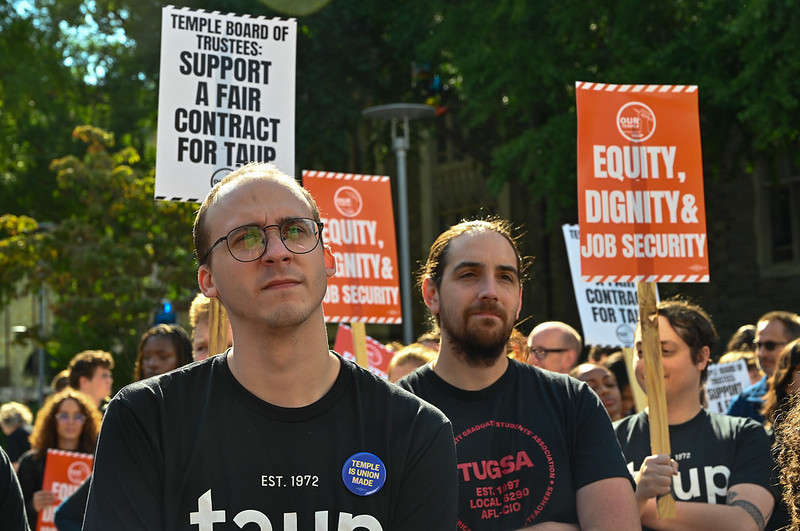
Consistently withholding all our labor maximizes the disruption of a strike and maximizes pressure on Temple administration to quickly settle a fair contract. The more our strike disrupts normal operations, the faster it will end, the less backlog you’ll have, and the better our new CBA will be. Performing any labor during a strike sells out your colleagues and your future self for your own short-term convenience.
All Temple employees are equally protected from retaliation for going on strike under state law, regardless of constituency or tenure status. Despite all of the public employee strikes in Pennsylvania since they became legal in 1970, we know of no permanently replaced strikers. It may not be legal in Pennsylvania to even try to replace striking public employees. But in any event, there is no practical way that Temple administration can replace a significant number of striking TAUP members, even if it were legal.
If TAUP were to call a strike, it would look different for different types of workers in the TAUP unit. Check below to see how a strike would impact different types of TAUP bargaining unit members.
Instruction/Clinical: Do not perform any work for your classes – don’t teach, grade, run lab sections, do clinical rotations, hold office hours or tutorial sessions, answer student emails, hold advising meetings with grad students, sign student forms, prep lessons, etc. Don’t provide your teaching materials, Canvas passwords, or anything else to your supervisor or a replacement worker.
Yes, even if your students need intensive support! The disruption caused by withholding your labor is what forces Temple administration to reach a fair contract.
Do not perform any research work – don’t go to the lab, attend conferences, write articles/books, read research-related articles/books, correspond with journals or coauthors, etc.
- Yes, even if your specimens will die! The disruption caused by withholding your labor is what forces Temple administration to reach a fair contract.
Service: Do not perform any service work – don’t attend committee meetings, review admissions/scholarship applications, interact with student work placements, correspond with committee members or disciplinary service organizations, organize conferences, etc.
- Yes, even if admissions cycles are thrown off! The disruption caused by withholding your labor is what forces Temple administration to reach a fair contract.
Do not perform any work at Temple – don’t teach, grade, hold office hours or tutorial sessions, answer student emails, prep lessons, etc.
Do not perform any work – don’t report to work in person or remotely, answer emails, or otherwise perform any job duties.
Do not perform any work – don’t report to work in person or remotely, answer emails, or otherwise perform any job duties.